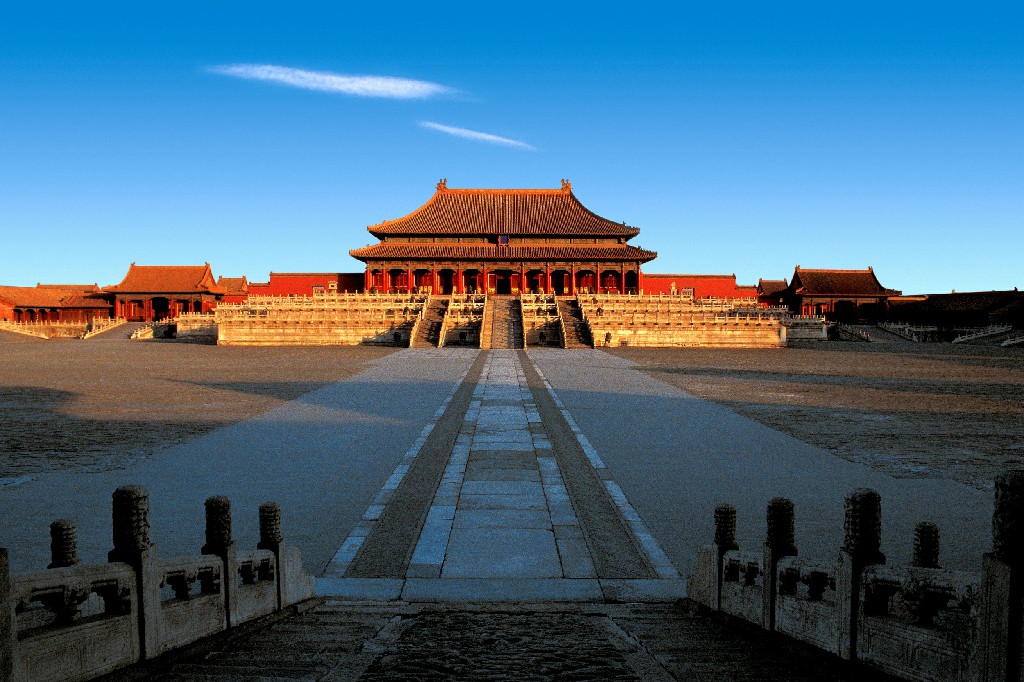
Forbidden City
Introduction
The Forbidden City, located in the heart of Beijing, served as the imperial palace for the Ming (1368-1644) and Qing (1644-1911) dynasties. Its construction began in 1406 and was completed in 1420 under the orders of the Yongle Emperor, the third ruler of the Ming Dynasty. Over nearly six centuries, it functioned as the residence and political hub for 24 Chinese emperors.
The rectangular complex covers approximately 720,000 square meters and measures 961 meters from north to south and 760 meters from east to west. It is enclosed by a ten-meter-high wall and a 52-meter-wide moat, with four watchtowers positioned at each corner. These watchtowers face the principal cardinal directions, ensuring strategic oversight of the palace grounds.
Architectural and Cultural Significance
The Forbidden City is a UNESCO World Heritage Site and a testament to traditional Chinese palatial architecture. It remains the largest collection of preserved ancient wooden structures in the world. The complex is composed of numerous buildings with a variety of purposes, including audience halls, living quarters, Buddhist shrines, a library and expansive gardens.
The layout of the Forbidden City reflects the principles of traditional Chinese architecture and follows the ancient belief in the cosmic significance of the emperor's abode. The centrality of the palace, correlated with the Pole Star (Ziwei yuan), was believed to represent the axis of the terrestrial world and the center of the heavens.
Historical Transition and Public Access
Initially commissioned by the Yongle Emperor of the Ming Dynasty, the Forbidden City later became the seat of power for the Qing Dynasty following the Manchu conquest in 1644. The last emperor to reside in the complex was Puyi, who was dethroned during the Revolution of 1911, better known as the Xinhai Revolution. Despite his abdication, Puyi continued to live in the palace until his expulsion in 1924.
In 1925, the Forbidden City was transformed into a museum, showcasing a vast collection of Ming and Qing Dynasty art and historical artifacts. It is now known as the Palace Museum and has become a major cultural institution, attracting millions of visitors from around the world each year.
Glazed Decoration and Symbolism
The Forbidden City is renowned for its vibrant array of colors, achieved through the use of glazed tiles called "liuli" in Chinese. These tiles decorate roofs, doors, and walls throughout the complex, emphasizing the imperial nature of the structures. The glaze work prominently features colors like green, yellow, blue, and black, each of which holds specific cultural meanings in Chinese tradition.
For example, black glaze is used on the roof of the Pavilion of Literary Profundity (Wenyuan Ge) due to its association with water, symbolically providing protection against fires for the imperial library. This attention to detail underscores the combination of art and practicality in the site's construction.
Construction Techniques and Resilience
Constructing the Forbidden City was an engineering feat, accomplished with limited technological resources in the early 15th century. Materials like nanmu wood were transported from vast distances via the Grand Canal, while massive marble structures were moved using innovative methods, such as using ice to facilitate transport during winter.
The Forbidden City has demonstrated enduring resilience, having withstood over 200 earthquakes, including the catastrophic Tangshan earthquake in 1976. This durability is largely attributed to the ingenious use of dougong brackets—complex wooden structures that provide both support and flexibility to absorb seismic shocks.








